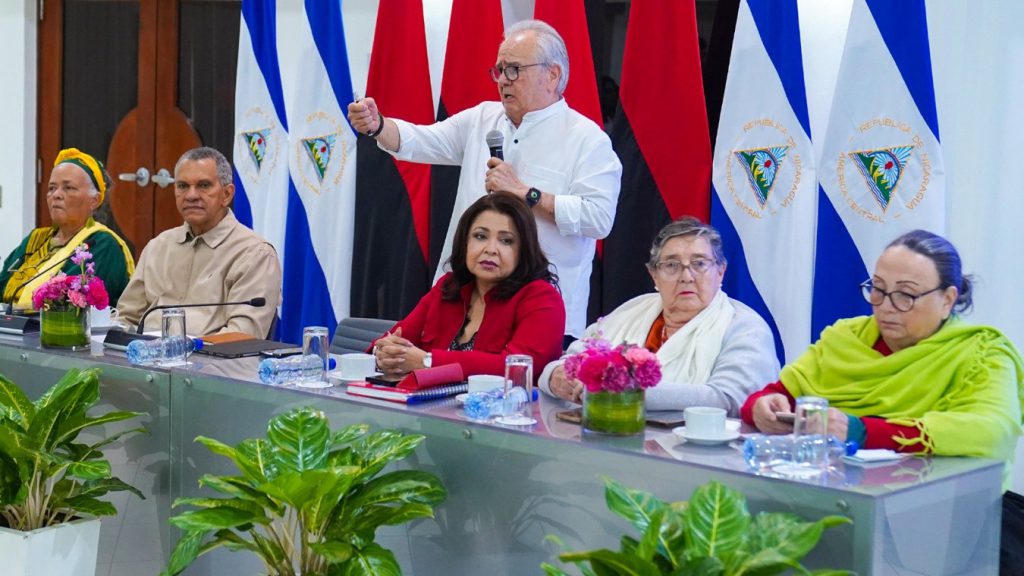
The Regional Governments and Councils of Nicaragua’s North and South Caribbean Coast expressed their support for the proposed partial constitutional reform during a consultation session led by National Assembly President Gustavo Porras and Commander Lumberto Campbell, Coordinator of the Secretariat for Caribbean Coast Affairs.
Regional authorities agreed that the proposed constitutional changes will strengthen identity-based development, as well as stability, security, and peace, as the foundations for the country’s well-being.
«Like the South Caribbean region, they have expressed their full support for the proposed constitutional reform to ensure the continuity of the path we have undertaken and to guarantee that progress toward a more dignified and just society is supported by security, stability, and peace,» Campbell said.
During the consultation, Porras explained that the proposed constitutional reform is built on three pillars—stability, security, and peace—which are regarded as essential conditions for ensuring the continuity of public policies and advancing the fight against poverty.
He also noted that the amendments are intended to strengthen institutions, consolidate national sovereignty, and improve the country’s legal framework.
The initiative preserves the holding of regular elections in Nicaragua and extends the terms of elected public offices to seven years, while maintaining citizens’ right to elect their authorities through the vote.
It also introduces provisions to strengthen the electoral system, establish new eligibility requirements for public office, and harmonize the terms of the country’s principal State authorities with the aim of providing greater institutional stability and administrative continuity.
What Is Nicaragua’s Constitutional Reform Seeking?
Porras presented an overview of the evolution of Nicaragua’s constitutional and electoral system, noting that during different historical periods the country was subjected to political models promoted under foreign influence.
In that context, he stated that the proposed reform seeks to consolidate a constitutional framework grounded in the principles of independence, sovereignty, self-determination, security, peace, and freedom from foreign interference.
The consultation with the Regional Governments and Regional Councils of Nicaragua’s North and South Caribbean Coast marked the twelfth session of the dialogue process led by the National Assembly’s Special Constitutional Commission to present and discuss the proposed partial reform of the Political Constitution and the corresponding amendments to the Electoral Law with different sectors and institutions across the country.